
【量化历史讲座系列37】内卷化还是工业化:从季节性角度重新解读19-20世纪的中国农业


独家抢先看

【量化历史网上讲座系列】(Quantitative History Webinar Series)由香港大学陈志武教授和马驰骋博士联合发起并举办,旨在介绍前沿量化历史研究成果、促进同仁交流,推广量化方法在历史研究中的应用。本系列讲座由国际量化历史学会、香港大学经济管理学院和亚洲环球研究所全力支持和承办。
讲座信息
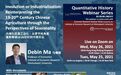
Involution or Industrialization: Reinterpreting the 19-20th Century Chinese Agriculture through the Perspectives of Seasonality(内卷化还是工业化:从季节性角度重新解读19-20世纪的中国农业)
主讲人: Debin Ma (马德斌), Professor of Economics, Institute of Economic Research, Hitotsubashi University
评论人:Kenneth Pomeranz (彭慕兰), FBA, University Professor in History and the College, The University of Chicago
评论人:Osamu Saito (斎藤修), Emeritus Professor, Hitotsubashi University
时间:2021年5月26日 09:45 - 11:30 (北京时间,星期三)
讲座语言:英文
讲座介绍
Chinese agriculture remains central to our understanding of China’s long-term Chinese economic growth trajectory and the Great Divergence debate. In this Quantitative History Webinar, Debin Ma of Hitotsubashi University revisits the debates of “involution” in the context of incorporating agriculture seasonality. China’s (or East Asian) highly crop-based agricultural economy generates sharply differentiated seasonable demand for agricultural labor across the year and leads to the rise of agricultural and handicraft side-employment and household production. Without taking proper account of this important intertemporal labor re-allocation mechanism, the “involution” thesis often posits a Malthusian diminishing return in Chinese agriculture due to deteriorating land-labor ratio.
Debin Ma and his co-author use empirical evidence from 19-20th century Chinese (and Japanese) agriculture to demonstrate that this labor relocation across seasons contributes to a Boserupian type of growth with rising commercialization and population density, but not necessarily urbanization, rising productivity and structural change. However, they argue that ultimately it was industrialization and the opening-up of markets, developments that occurred outside agriculture that pulled China (or Japan) out of the “involutionary” path and took China onto a path of modern economic growth.
Debin's co-author: Kaixiang Peng (Henan University)
中国农业一直是中国长期经济增长轨迹和大分流辩论的核心问题。于本次量化历史网上讲座中,日本一桥大学经济史学者马德斌教授从农业季节性的视角出发,重新审视关于中国「内卷化」的争议。在中国(和东亚地区)农耕经济中谷物生产占有超高的比重,由此所导致的农业劳动力需求十分显着的季节性波动,带动了农业副业和家庭手工业的兴起。但「内卷化」理论在很大程度上把这种跨季节劳动力的优化再分配,单纯得解释为源于土地劳动力比率的不断下降而导致劳动生产力报酬递减的马尔萨斯(Malthusian)式陷阱。
马德斌和他的合著者彭凯翔教授利用19至20世纪中国和日本农业的实证证据来显示这种跨季劳动力重新配置提升了商业化和人口密度,但这一所谓柏泽尔普式(Boserupian)的增长模式,却不会触发城市化、劳动生产力上升和经济结构变化的现代式经济增长。马德斌教授将于讲座中解释中国(或日本)最终成功脱离「内卷化」并走上现代经济增长的动力来自于农业之外的因素,即现代工业化的兴起和市场规模的大大扩张。
“特别声明:以上作品内容(包括在内的视频、图片或音频)为凤凰网旗下自媒体平台“大风号”用户上传并发布,本平台仅提供信息存储空间服务。
Notice: The content above (including the videos, pictures and audios if any) is uploaded and posted by the user of Dafeng Hao, which is a social media platform and merely provides information storage space services.”